
Day 1 Activities
Session 1
Session title
Let’s meet each other and find out more about ourselves!
Goals
- To get to know each other
- To create a safe working atmosphere
- To start with group building
Activities
Introduction to the training and presentation of the programme
Trainers ask participants to share their name and country/place they are coming from. When the round is finished, trainers greet the participants and tell them that we will be dealing with the topic of mental health and fake news. The presentation of the goals and programme is made. Participants are asked if they would change something in the schedule.
Name game
Participants are invited to stand up and tell their name. They should tell their name and adjective which starts with the same letter of their name (e.g. Adventurous Anna, Bold Bogdan…). The first person kicks off, and the second person should repeat the name and adjective of the first person and add theirs. Third person should repeat names and adjectives of the first two people and add theirs. The circle is closed in the end when all participants finish saying their name.
Group building: save an egg!
Participants are divided into 3 or 4 groups. All groups are given the same
materials and task of creating a contraption that will save the egg from breaking after being thrown off the second floor of the building. Give participants enough time to make contraption.
Drop is performed and discussion about the process is held
o What happened during the activity?
o How did you feel during activity?
o What was (not) working in your cooperation?
o What would you do differently now?
o How is this exercise connected with our training?
Trainers add what is also important from this exercise to take to the training: listening, active communication, asking questions, and working as a team.
Session 2
Session title
What do I want to get from this?
Goals
- To get to know each other
- To share expectations, contributions and things they would like to avoid
- To create working agreement for the rest of the training course
Activities
Get to know my shield
Participants are invited to create their own “shield”, where they should present themselves. Firstly, give participants 10 minutes to DRAW in their shield the answers to the following questions:
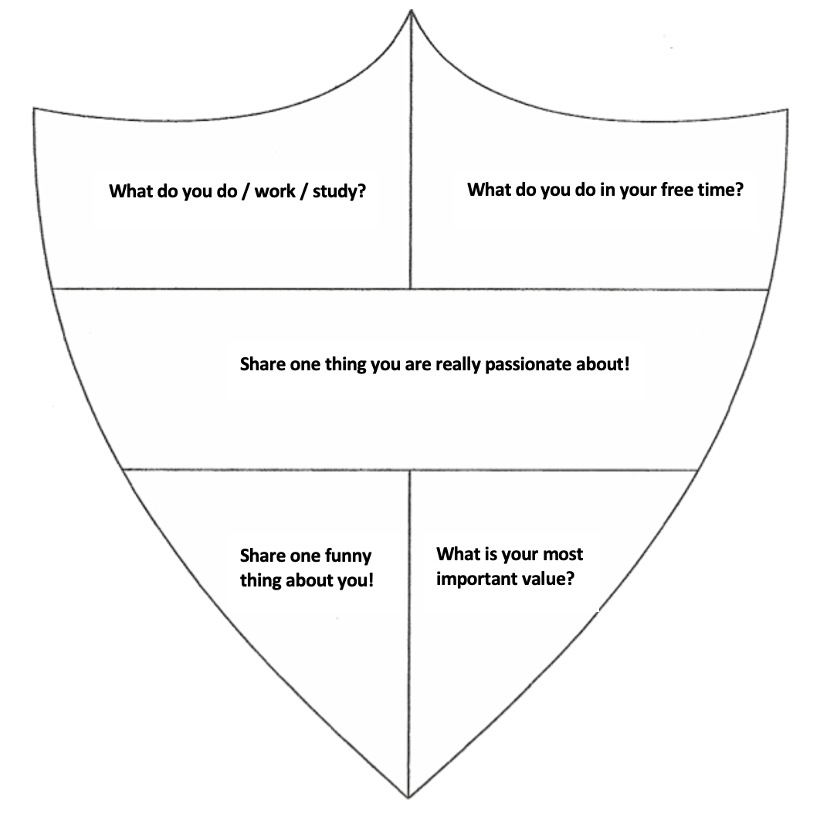
After they have drawn inside their shield, ask them to find someone they don’t know. They should give their paper to the other person and the person should in 3 minutes give answers to the drawings. The person whose drawing is being interpreted is not talking, only if the other person really misses the point. The roles then change and the procedure is the same.
Afterwards, participants are invited to present each other through shields to the whole group.
My quadrant: Fears, hopes and contributions
Participants are then invited to talk a bit more about their fears, hopes and contributions, as well as needs. Participants are given 4 different colors of post-it and 4 flip chart papers. On the top of the each flipchart paper, there is a question written with a specific color:
- What do I want to achieve? What do I want to get out of this training course?
- What do I need from the group in order to feel comfortable and have a good working environment?
- What do I bring to the group (skills, methods, values, or anything else)? How can I contribute?
- What would I like to avoid happening?
Firstly, participants have 10 minutes to fill in their post-it´s. They should write individually and than when they are finished, put their post-it on the flipchart. When they are finished, divide participants in 4 groups. Task of each of the groups is to summarize what was written and make the list of the most important findings. They have 20 minutes to do it. When they are finished, they should be prepared for the presentation. Each presentation will last up to 5 minutes.
When everything is finished, ask participants how they feel with these lists. Can we, based on the lists, create a common working agreement?
Based on the discussion, the trainer creates a working agreement.
Session 3
Session title
Media… all around us!
Goals
- To define the media and their role
- To introduce the media field and actors in media
Activities
What is the media?
Participants are asked to take as many post-its they want. They should, in this brainstorming session, write everything that comes to their mind when writing the word media. When everyone is finished, the task of the trainer is to distinguish tow parts: one will be associations with media types (newspapers, TV, radio, social media…), others will e connected with the media field (editors, publishers, journalists, information…)
After you have done this, tell participants that usually we talk about these two in media literacy – who are the actors and what are the media types. Afterwards, ask them to take all of these associations and in small groups they should try to create their definition of media.
Definitions are presented. Trainers in the end give the official definition by UNESCO and mention that media are editorial mediated content.
Media actors and media field
Participants are introduced to the media field, as a place where different actors are active and they have their own interest. They will have to explore the media field a bit more. Every group will get two actors, and their task is to think:
- What is the role of this actor?
- What is their interest in participating in the media field?
- What do they expect from other actors?
The actors are: government, public media, publisher of commercial media, publisher of nonprofit media, journalists’ association, consumers (readers or viewers).
Afterwards, each group presents their findings and debate is held around the main interests and what the actor wants to achieve, and what do they expect from others to do.